Minister for Health and Chief Medical Officer urge public to “Be Tick Aware” during peak Lyme disease season
The Minister for Health, Jennifer Carroll MacNeill TD, today marked Tick Awareness Day, urging people to take simple preventive steps to protect themselves against tick bites and Lyme disease as outdoor activity increases during the spring and summer months.
Lyme disease, also known as Lyme borreliosis, is an infection transmitted to humans through the bite of infected ticks and can, in some cases, lead to serious illness. Ticks are present throughout Ireland, in both urban and rural settings. While ticks can be active at any time of year, the period of highest tick activity and therefore risk of Lyme disease is between spring and autumn months.
Public health advice and resources:
The HSE’s National Health Protection Office, through the Health Protection Surveillance Centre, (HPSC), has responsibility for the surveillance of Lyme disease in Ireland. The HPSC provides a wide range of information and resources to help people reduce their risk of tick bites, including seasonal updates for both the public and healthcare professionals.
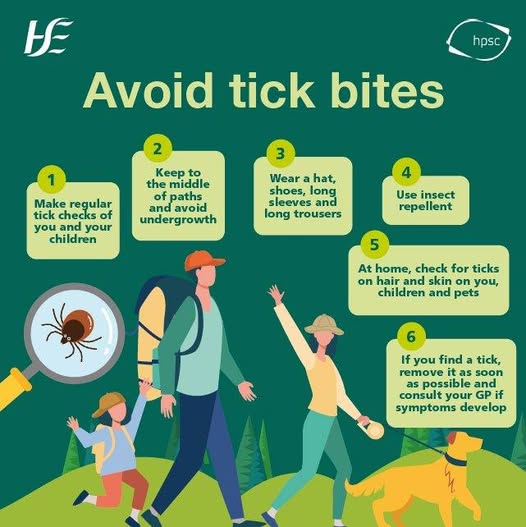
Each year in early May, the HSE marks Tick Awareness Day by providing practical advice on the prevention of tick bites that can transmit Lyme disease. This public information campaign is delivered through website news articles, social media content, press releases and media interviews.
The campaign focuses on:
-
Common tick habitats across Ireland including parks, woodland and grassland
-
Activities that increase the risk of tick exposure
-
Practical prevention measures
-
How to safely remove a tick
- To further support public awareness at local level, the HSE provides downloadable posters and information leaflets that can be displayed in community centres, schools, recreational areas and other public or private spaces, particularly those where there is an increased risk of tick exposure.
- A full suite of Lyme disease resources, including posters and leaflets, is available on the HPSC website. These materials are suitable for display on publicly accessible land and have been actively promoted to Government Departments, public agencies and local authorities that manage such areas. Healthcare professionals, community organisations and members of the public are encouraged to download and share these resources widely.
- How to remove an attached tick
-
- If you find an attached tick, remove it by gently gripping it as close to the skin as possible using a pair of fine tipped tweezers or tick removal tool
- Pull steadily away from the skin without twisting or crushing the tick
- Wash your skin with warm water and soap afterwards, and apply an antiseptic cream to the skin around the bite
- Do not use a lit cigarette end, a match head, or substances such as alcohol or petroleum jelly to force the tick out.
The HSE Health Protection Surveillance Centre (HPSC) has significant support and information concerning Lyme disease on its website for both health professionals and the public available here and here. Further information on Lyme disease is available on the HSE website here.